
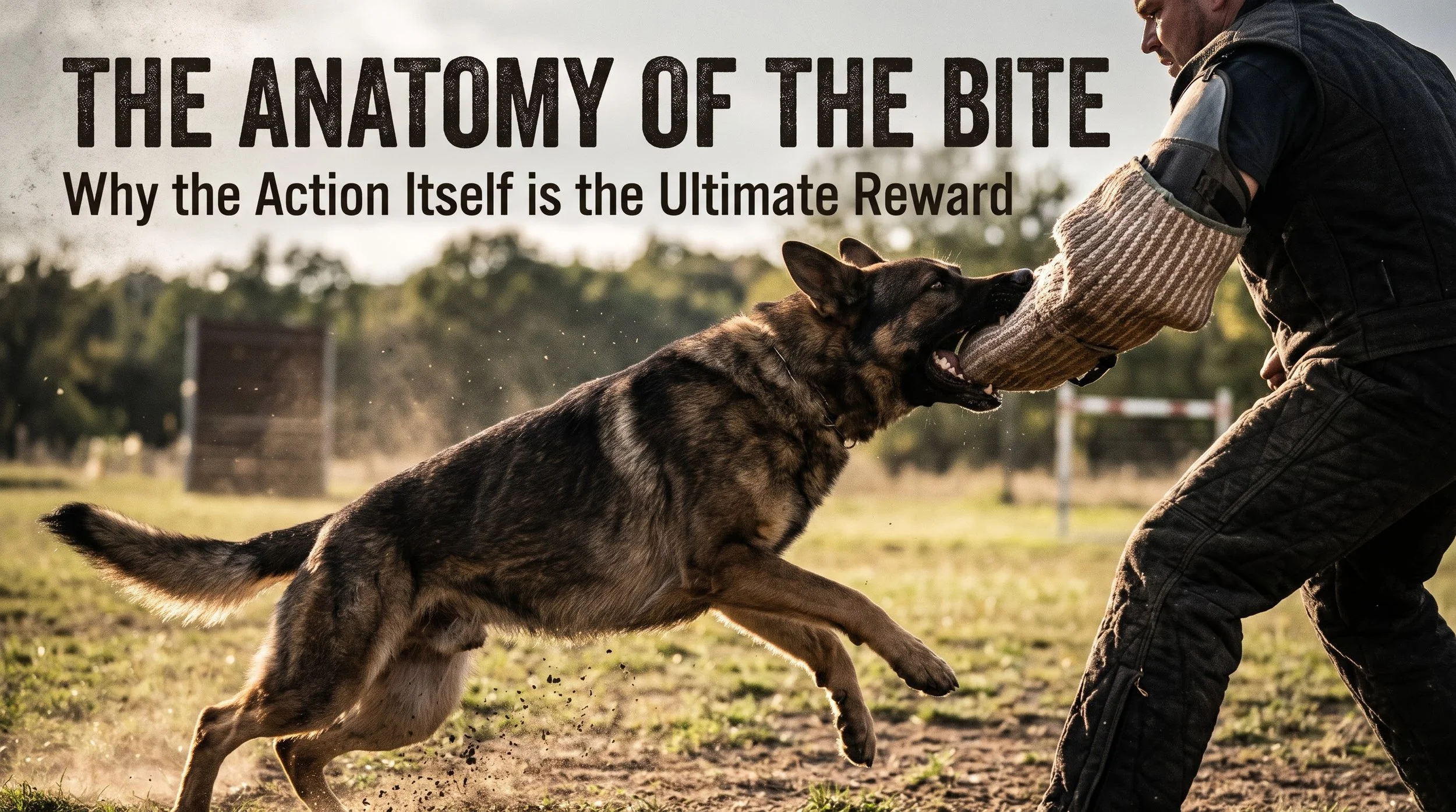
The Anatomy and Science of the Bite: Why the Action Itself is the Ultimate Reward
By: Max Taylor
When we observe a dog locking powerfully onto a target, whether it is a working dog executing a full bite on a sleeve, a hunting dog catching prey, or a pet dog pulling hard on a tug toy, we are not merely witnessing a mechanical physical action or a display of strength. We are actually observing a masterpiece of evolutionary biology. To truly decode the dog's behavior in these critical moments, we must shift our gaze from the jaws into its central nervous system.
One of the most common misconceptions in the world of protection and sport dog training is the assumption that the reward for the dog is when the decoy releases the sleeve, allowing the dog to take it, step away, and carry it around as a reward. However, the biological and behavioral reality presents a completely different picture: the physical pull, the active struggle, and the act of biting itself are the actual reward. In professional terminology, we define this as Self-Rewarding Behavior.
To understand the deep root of this behavior, we will first examine the internal chemical engine that drives it, and then dive into the scientific evidence that established this understanding.
Part A: The Chemical Storm, Quantities, and the Illusion of Equipment vs. the Human
From the moment the dog locks onto the target until the jaws close, an eruptive chemical storm takes place in its body. It is controlled by two critical substances acting in perfect synergy: adrenaline and dopamine.
Adrenaline (Epinephrine): The Fuel of the Survival Engine
As drives elevate, the adrenal gland injects adrenaline directly into the bloodstream in massive quantities. Adrenaline is the dog's physiological fuel.
In numbers: Within mere seconds from a baseline state, adrenaline levels in the blood spike by 10 to 50 times (an increase of 1,000 percent to 5,000 percent). Simultaneously, the heart rate can soar from a resting average of about 70 beats per minute to over 200 beats per minute (a 300 percent increase).
This flood delivers oxygen to the skeletal and jaw muscles at a dizzying pace and temporarily shuts down pain receptors. The extreme spike allows the dog to ignore environmental obstacles, physical fatigue, or pain, turning it into a machine calibrated purely for mission execution.
Dopamine: The Mental Laser and Ultimate Satisfaction
While adrenaline provides physical resilience, dopamine provides the mental why. Dopamine is the neurotransmitter responsible for the reward and motivation system in the brain. The moment the jaws close and the dog achieves a stable grip, the brain releases a massive dopamine hit into the pleasure centers.
In numbers: During pursuit and upon achieving a grip, dopamine levels in the reward system spike by 3 to 10 times (an increase of 300 percent to 1,000 percent) compared to a quiet state. The dog does not need external validation; its brain has already provided the most addictive and powerful reward that exists in nature.
Between Prey and Fight: The Sleeve Illusion vs. the Real Confrontation
This is exactly where the subtle yet critical difference lies between a dog working solely out of prey drive and a true protection dog. On many training fields, we see a common sight: the dog bites the sleeve, the handler or decoy releases the equipment, and the dog runs with the sleeve in its mouth on a victory lap, taking pride in its captured loot. In this state, the dog is satisfying nothing but its prey drive. The sleeve, to the dog, is simply dead prey successfully obtained.
But when we examine a true protection dog, the picture changes entirely. Such a dog does not need the sleeve as loot. On the contrary: if the person drops the sleeve, or slips out of a bite suit jacket or pants, the true protection dog will abandon the orphaned equipment in a fraction of a second. It will spit out the fabric and charge directly at the person to deliver a real bite.
Here, the Defense Element and the Fight Element are expressed in their purest form. For this dog, the massive dopamine and adrenaline hit is not released by holding a piece of jute. The immense chemical reward is fueled by the direct confrontation, the dominance, and the control over the live human opponent. The defense drive and fight drive mechanisms identify the human as the threat or the rival, making the equipment irrelevant the moment the person disconnects from it. The opponent is the man, not the fabric on his arm.
The Head-On Collision with the Out Command
Given these numbers, it is perfectly clear why releasing the jaw under high drive load (the Out command) is such a complex demand. Asking the dog to open its mouth is not just a mechanical action; it means demanding the dog to voluntarily cut off a 1,000 percent dopamine jump that is flooding its brain with euphoria. Overcoming chemistry of this magnitude requires foundational mechanical work, high discipline, and psychological control.
Part B: The Science Behind the Jaw - The Evidence Base
Since it is technically and ethically impossible to put a working dog at the peak of an attack into a real-time MRI brain scanner, the scientific conclusions we rely on today are derived from the cross-referencing of three distinct research fields:
Bullet Affective Neuroscience
This research field, led by scientists like Prof. Jaak Panksepp, proved the universality of reward systems in predatory mammals. Panksepp mapped the SEEKING System, a brain network driven exclusively by dopamine. Laboratory experiments revealed that pharmacological blocking of dopamine receptors completely eliminates the animal's desire to chase or catch prey, while stimulating the network triggered an obsessive drive to continue searching and hunting. These studies established that the initial drive and reaching the target release an immediate chemical reward, long before and regardless of any food consumption.
Bullet Ethology and the Evolution of Behavior
Prominent animal behavior researchers, notably Prof. Raymond Coppinger in the specific context of dogs, analyzed the predatory motor sequence as a Fixed Action Pattern. In nature, completing this pattern is programmed to release a biological reward to ensure the survival of the species. Coppinger documented how thousands of years of artificial selection by humans isolated segments from this evolutionary sequence (like the bite drive) and amplified them genetically in working dogs, so that the act of the grip itself became the ultimate satisfaction, disconnected from any real need for feeding.
Bullet Applied Animal Behaviour Science
To back up laboratory conclusions, researchers went to the field. Veterinary behaviorists, such as Dr. Esther Schalke from Germany, used telemetry technology on security and sport dogs during work.
Using monitors to measure Heart Rate Variability and saliva samples before and after a bite, they quantified the adrenaline and cortisol spikes. Field results confirmed the laboratory numbers: increases of hundreds and thousands of percent in sympathetic nervous system metrics within seconds. Furthermore, the rapid recovery of the dogs immediately after the attack ended, returning to resting metrics, proved that this physiological storm was experienced by them as a satisfying positive excitement (Eustress), rather than a state of distress.
Summary
When we analyze canine behavior, breaking it down into dynamic elements like the defense and fight elements as we do in the CDPEM framework, a clear picture emerges: there is no need for an advanced brain scanner to recognize this physiology in the field. Any professional who has seen a working dog ignore a dropped sleeve, bypass it, and demand a direct confrontation with the man himself, has witnessed firsthand how dopamine and adrenaline generated by a real conflict conquer any other conditioning.
The dog is a practical creature. It surrenders to what satisfies its deep genetic needs. When we understand that the bite and the confrontation are not just behaviors but a self-rewarding biological addiction with thousands of percent increases in neurotransmitters, we learn to respect the powerful engine beating inside. Professional training does not fight this nature, but harnesses it, and science, in our case, merely provided the official confirmation for what people in the field have always known.
