
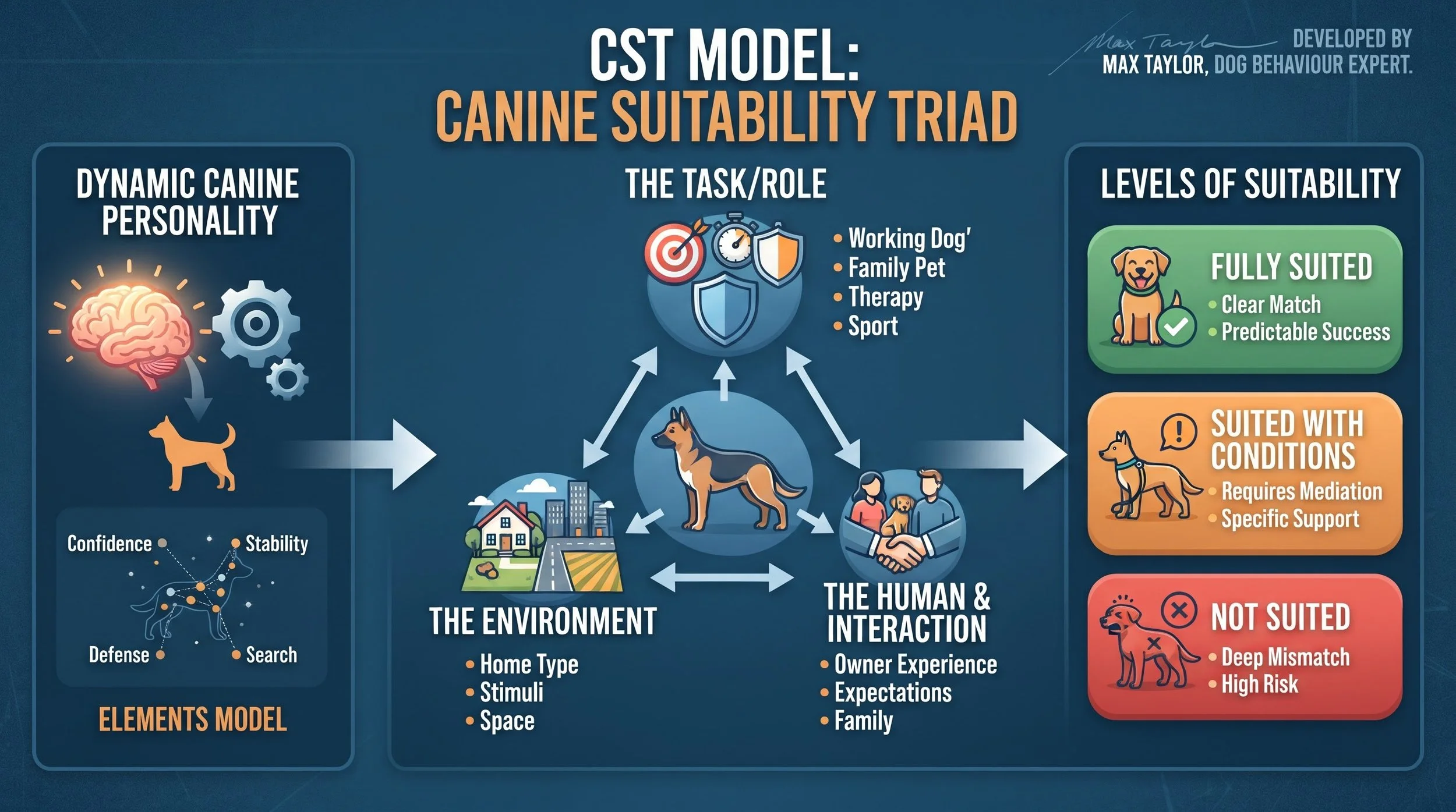
The CST Suitability Model: Three Levels of Canine Suitability
Model Developer: Max Taylor, Dog Behaviour Expert
Chapter Introduction
A dog is not evaluated solely by temperament, size, or obedience level, but by how accurately it fits a specific task, environment, and the people it interacts with. That is where the Canine Suitability Triad (CST) comes in - a practical model designed to evaluate in the field, clearly and accurately, how well a dog fits different roles, living conditions, and human interactions.
The model serves as a key link within the theory of Dynamic Canine Personality Structure and the Elements Model, allowing us not only to understand a dog's elemental makeup, but also where the dog fits, what is needed for it to succeed, and where clear boundaries must be set.
The Canine Suitability Model (CST)
The Canine Suitability Model, CST (short for Canine Suitability Triad), is a practical model built to assess in the field how well a given dog fits specific tasks, living environments, human interactions, and working roles.
The model is designed for trainers, behaviourists, working-dog professionals, rescues, adoptive families, and anyone who wants to understand how well a specific dog fits a specific context - not just "in general."
Core Principle
The model rests on a simple yet fundamental principle: suitability is not a fixed trait; it is relative to context.
A dog can be completely suited to one task or role, partially suited to another, or completely unsuited. Therefore, before evaluating suitability, the dog's role or task must be clearly defined, and suitability is then assessed along a continuum rather than as a binary "yes" or "no."
The Three CST Suitability Levels
Fully Suited The dog shows clear, stable, and predictable suitability for the defined role or environment. No special environmental adjustments or unusual supervision are required.
Suited With Conditions / Limitations Partial or potential suitability exists for the role or environment, but specific conditions are required for the match to succeed - such as supervision, appropriate experience, professional guidance, or environmental adjustments.
Not Suited There is a deep mismatch between the dog's needs and elements and the demands of the role or situation. Such a pairing can lead to distress, risk, or deterioration.
Guiding Principles of the CST Model
First define the dog's role or task, and evaluate suitability based on that.
Suitability is always evaluated within a specific context - no dog is "suited for everything."
A specific element or combination of elements can be an advantage or a liability depending on the role and context.
Connection to the Dynamic Personality Model and the Elements Model
The CST model connects directly with the theory of Dynamic Canine Personality Structure and the Elements Model. While the personality and elements models help us understand a dog's internal dynamics - which elements are dominant, what drives the dog, and how it responds - the CST model helps us see, once the role is defined, where the dog is likely to succeed, when mediation is required, and what its limits are.
Practical Field Examples:
Family dog under specific conditions: A dog with a high defense element along with high mental stability and the ability to function under stimuli and provocations within a family can fit as a family dog only under specific conditions - for example, with an experienced owner who has proper control, understanding, and a suitable living environment.
Family dog for any family in any situation: A dog with little or no defense element that is completely social, mentally stable, self-confident, and does not respond to pain with aggression can fit as a family dog for almost any family in any situation.
A dog not suited for family or therapy work: A dog with low self-confidence, high dominance, and a tendency toward aggression against family members or children is not suited for an inexperienced family or a family with young children at all, and is not suited at all for therapy dog work.
Similar principle in working dogs: In the exact same way, with working dogs, the task must be defined first, and then evaluated to see whether the dog is fully suited to the task, partially suited under specific conditions, or not suited at all.
Purpose of the Model
To prevent mismatches between dogs and living environments or tasks - mismatches that lead to disappointment, frustration, behaviour problems, and sometimes danger and rehoming.
By clearly defining the role and matching the dog's elements to the demands of the context, we can create success, fulfill potential, and support genuine well-being for all involved.
CST Suitability Assessment Questionnaire
The following steps guide a structured, thorough, and practical evaluation in the field.
Step 1: Define the Role and Context
What is the role or situation the dog is entering? (Family with children, small city apartment, yard, working dog, therapy tasks, time alone, etc.)
Which elements and response patterns are required to succeed in this role? (Calmness, low reactivity, play drive, social connection, ability to work under pressure, etc.)
Step 2: Identify the Dog's Elemental Profile
Which elements are prominent and dominant in the dog? (Defense element, search element, dominance, stability, self-confidence, reactivity to pain or stimuli, etc.)
Which drives and impulses operate through these elements? (Prey, defense, play, bonding, control, survival, etc.)
What limitations and sensitivities exist in how these elements function? (Fears, anxiety, sensitivity, need for close supervision, trauma, medical issues, etc.)
Step 3: Cross-Check the Dog Against the Role and Environment
Is there a direct alignment between the demands of the role and environment and the dog's elements and capabilities?
Can conditions be created that allow success even without a full match? (Such as training, changing the environment, adjusting expectations, emotional mediation, appropriate experience of the handler or owner, etc.)
Step 4: Determine the Suitability Level
Based on all the data, determine the suitability level for the defined role:
Fully Suited
Suited With Conditions / Limitations
Not Suited
Step 5: Summary and Conclusions
What must change to make success possible?
Is the environment or system actually ready for this?
Is additional professional guidance needed?
Professional CST Suitability Questionnaire
(Includes separate sections for professional purposes)
Main sections:
Role definition, living environment mapping, and context requirements
Defining the desired elemental profile of the dog (including the human's emotional approach)
Dedicated dog questionnaire for a professional goal (protection, sport, search, therapy)
Assessment of the owner's or handler's experience level, control ability, and resources
Compatibility check between the dog's elemental profile and role requirements
Practical Use of the CST Model
Using the CST model provides a systematic, grounded, and consistent process for evaluating any dog's suitability - whether for working, companionship, therapy, or rehabilitation.
This model is built on a deep understanding of canine elements and internal canine dynamics, grounded in respect for the dog's real needs rather than human convenience alone. It is designed to serve the best interests of everyone involved - the dog, the family, and the human environment in which it lives and works.
